
Why Do Commercial Buildings Have Flat Roofs?
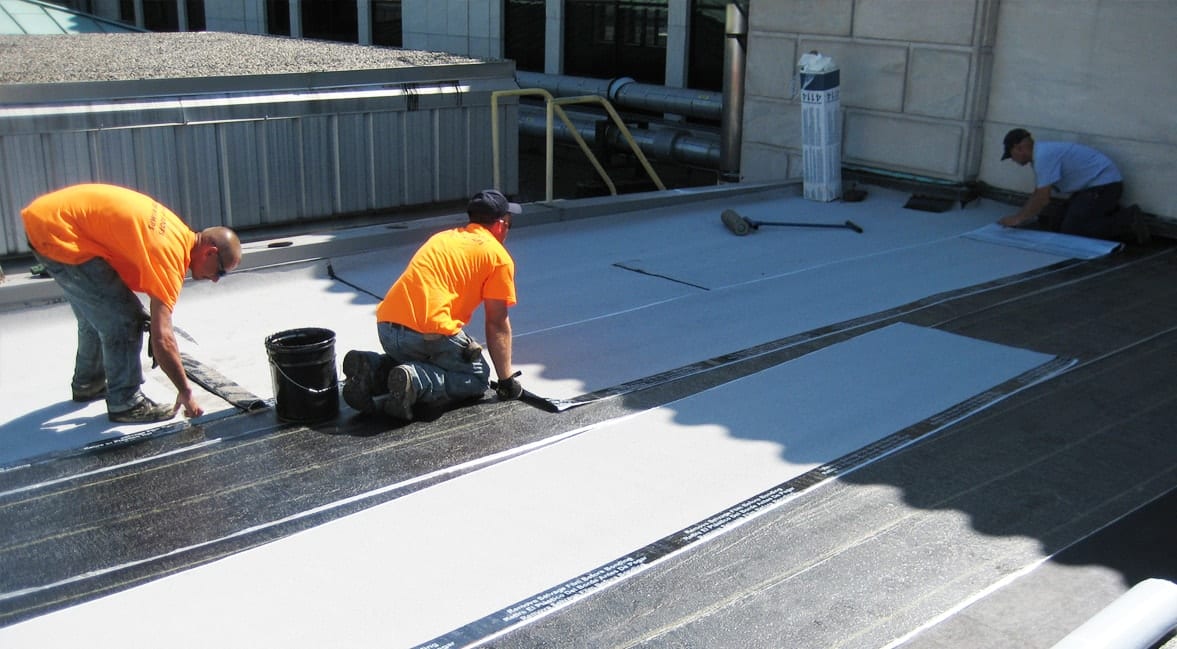
If you've ever looked out over the skyline from a high floor in Midtown, or driven through an industrial stretch in Queens or Brooklyn, you've noticed the same thing: almost every commercial building has a flat roof. Warehouses, office buildings, retail strips, mixed-use properties they all share that same low, level roofline.
It's not a coincidence, and it's not just a style choice. There are real, practical reasons why commercial construction settled on flat roofs decades ago and never looked back. Here's what's actually driving that decision.
It Costs Significantly Less to Build
The most straightforward reason is money. Commercial buildings are large, and the bigger the footprint, the more the roof design affects the overall construction budget.
A pitched or gabled roof requires more materials, more complex framing, trusses angled at precise degrees, and more labor hours to install safely at height. Multiply all of that across a 20,000 square foot warehouse and the cost difference becomes substantial very quickly.
A flat roof uses a simpler structural system. There's no ridge, no angled rafters, no triangular framing to engineer. You span the width of the building with horizontal supports, lay down your decking, and apply the membrane. For a commercial developer or building owner watching a budget, that simplicity translates directly into savings on day one.
It Gives You Somewhere to Put Everything
Walk onto most commercial flat roofs in NYC and you won't find empty space. You'll find HVAC units, condensers, exhaust fans, ductwork, electrical equipment, satellite dishes, and sometimes solar panels. That rooftop is essentially a mechanical floor without walls.
On a pitched residential roof, none of that equipment has a natural home. You'd need to find ground-level space, build enclosures, or engineer platforms just to hold what a flat roof accommodates without any extra effort. For a commercial building where the HVAC system alone might weigh several tons, having a stable, accessible, horizontal platform overhead is a genuine operational advantage.
It also keeps all of that equipment out of sight, off the street, and away from the building's footprint, which matters a lot in dense urban environments like Manhattan or Downtown Brooklyn where every square foot of ground-level space has value.
Workers Can Actually Get Up There Safely
Maintenance on a commercial building is ongoing. HVAC filters need replacing, drains need clearing, membranes need inspecting after a hard winter. Solar panels need servicing.
On a flat roof, a roofer walks up through a hatch or an access door, does the work, and walks back down. No harnesses required for routine tasks, no complicated rigging, no steep pitches to navigate carefully. That accessibility matters because maintenance that's easy to do actually gets done. Maintenance that requires special equipment and a half-day setup tends to get postponed, and postponed maintenance is how small problems become expensive ones.
For building owners managing multiple properties or large commercial spaces, the time and labor cost saved on routine roof access adds up over years of ownership.
Large Buildings Simply Don't Work Well With Pitched Roofs
Think about the geometry for a moment. A standard residential gable roof works because the building it sits on is relatively narrow. The two slopes meet at a ridge somewhere in the middle, and the height of that peak is proportional to the width of the building.
Now imagine trying to put a gable roof on a building that's 150 feet wide. To maintain a reasonable pitch, you'd need a ridgeline that sits three or four stories above the roofline. The structural complexity alone would be enormous, and the wasted space inside that triangular void would be significant. For wide-span structures, flat roofs aren't just cheaper. They're the only design that makes structural sense at scale.
This is why you see flat roofs not just on commercial buildings but on schools, hospitals, government facilities, and any large institutional structure. The architectural logic is the same across all of them.
They Handle NYC's Urban Density Better
New York City has specific pressures that make flat roofs especially practical. Buildings sit close together. Streets are narrow. Neighboring properties share walls in many cases. A pitched roof in that environment creates drainage problems, shadows, and structural complications that simply don't exist with a flat design.
Flat roofs also align naturally with the parapet walls that are standard across NYC commercial and mixed-use buildings. The parapet hides rooftop equipment from street view, helps with drainage, and satisfies building code requirements for safety. It's a system that's been working across Brooklyn row houses and Manhattan commercial blocks for well over a century.
They're More Energy Efficient Than They Used to Be
This point has become more relevant in recent years, particularly with New York City's Local Law 97 putting real pressure on commercial building owners to reduce energy consumption.
Modern flat roof membranes, particularly TPO and certain PVC systems, are highly reflective. They bounce sunlight rather than absorbing it, which reduces heat gain in summer and lowers the cooling load on the HVAC system. On a large commercial roof, that reflectivity can meaningfully reduce energy costs across an entire cooling season.
Green roof installations, where a layer of vegetation is grown over a waterproof membrane, are also far more practical on a flat surface. Several commercial properties across the five boroughs have added green roofs in recent years, both for insulation benefits and to meet sustainability requirements. None of that is feasible on a pitched roof.
So Why Don't Residential Buildings Use Flat Roofs More?
Many do, especially in NYC. Brownstones, townhouses, and row homes across Brooklyn, Queens, and the Bronx have flat roofs precisely because they share the same urban logic as commercial buildings: dense blocks, shared walls, and the value of usable rooftop space.
Where you see pitched roofs in the city is mostly on detached single-family homes, the kind you find in parts of Staten Island, eastern Queens, and the Bronx. Those buildings were designed more like suburban homes, and in that context, a gabled roof with shingles makes sense. The footprint is smaller, the pitch handles snow and rain efficiently, and the neighborhood character calls for it.
For attached buildings of any kind, and certainly for any commercial structure, flat roofs remain the dominant and most practical choice.
Already Have a Commercial Flat Roof That Needs Attention?
Flat roofs on commercial properties need regular inspection and maintenance to perform well over their full lifespan. If your building's roof is more than 10 years old, has experienced any leaks, or hasn't been professionally inspected recently, now is the right time to get ahead of it.
Roof On NYC handles commercial flat roof installation, repair, and maintenance across Brooklyn, Queens, Manhattan, and surrounding areas. We're licensed, insured, and available around the clock for emergencies.
📞 Call or text (929) 720-4223 📧 roofonweb@gmail.com 📍 530 83rd St, Brooklyn, NY 11209
Related reading: